
Children's dentistry in Dortmund
Children's dentistry in Dortmund means prevention first: the first examination while your child is still small, regular prevention appointments and the right first care when a milk tooth is affected or a tooth has been injured. We take our time so that your child can get to know the practice without fear.
Dental care milestones for children in Dortmund
This overview shows when which kind of prevention is usual, from brushing in the first year of life to individual prevention in adolescence.
From the first tooth
Brushing twice a day
As soon as the first milk tooth appears, brush twice a day: with a smear of children's toothpaste containing 1000 ppm fluoride, the size of a grain of rice.
Month 6 to 33
Early detection in early childhood
Three dental early detection examinations: getting used to the practice, advice on oral hygiene and fluoride varnish to harden the enamel.
Month 34 to 72
Prevention until the sixth birthday
Three further early detection appointments. The toothpaste is now dosed the size of a pea, still with 1000 ppm fluoride.
From age 6
Individual prevention
Annual check-ups, fissure sealing of the permanent molars and, if needed, professional dental cleaning.
From age 12
Bonus booklet
The annual examinations are recorded in the bonus booklet, a later proof for higher subsidies for dental prosthetics.
Children's prevention in numbers
Regular prevention works, as the large German oral health studies show.
0 to 6
years: six dental early detection examinations covered by statutory insurance
Source: G-BA, FU-RL
up to 18
years: entitlement to fissure sealing of the permanent molars
Source: GKV benefit, G-BA
0.5
teeth with experience of caries on average in 12-year-olds in Germany
Source: IDZ, DMS V (2014)
81 %
of 12-year-olds were free of caries in the DMS V
Source: IDZ, DMS V (2014)
Data from publicly available recommendations and study results. They do not replace individual advice.
What to expect
Every treatment begins with a detailed conversation. You decide, we advise honestly, understandably and without pressure.
First examination: the first visit to the dentist
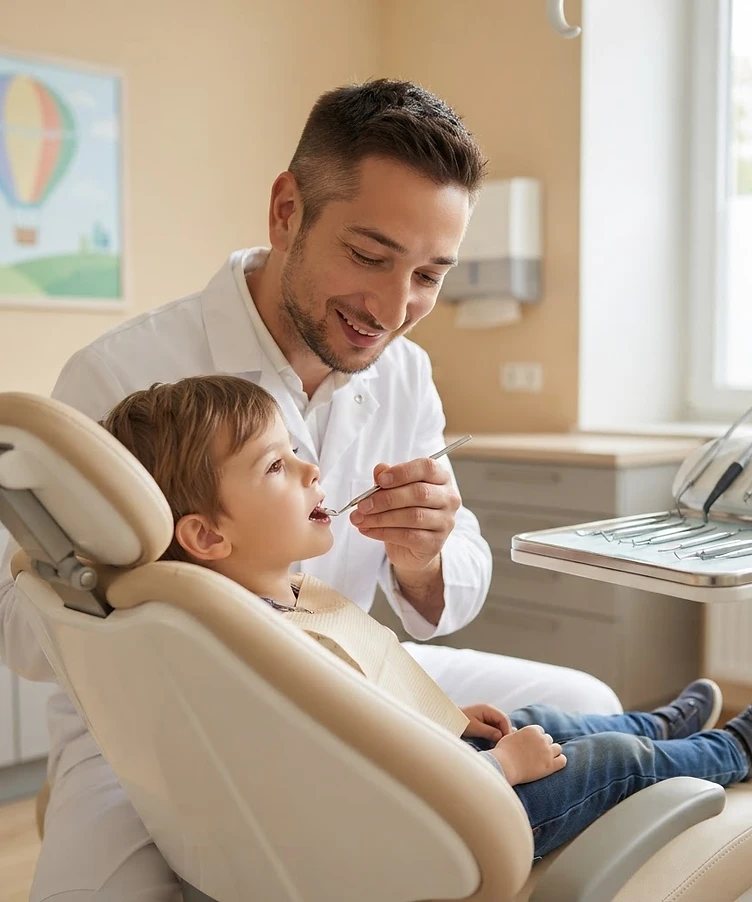
The first examination does not have to be a big event. We show your child the treatment chair, speak calmly and look at the teeth once your child is ready. We answer parents' most important questions about oral care, fluoride and the risk of caries.
Early detection in the first three years
Children with statutory insurance are entitled to six dental early detection examinations from the sixth month of life until their sixth birthday. In the first three years these appointments are about getting used to the practice, advice on oral hygiene and applying fluoride varnish to harden the enamel.
Children's prevention: fluoride and oral hygiene
Prevention includes check-ups, fluoride varnish and guidance on the right oral care. We recommend brushing twice a day with children's toothpaste containing 1000 ppm fluoride: a smear the size of a grain of rice until the second birthday, the size of a pea afterwards.
Fissure sealing of the permanent molars
The grooves of the permanent molars can hardly be cleaned with a toothbrush. A thin seal protects them from caries and is covered by statutory insurance for children and adolescents up to the age of 18.
Nutrition and caries prevention in children
Frequent sugary snacks and constant sipping of sweet drinks are among the most common causes of caries in the milk teeth. We discuss with you how drinking habits, snacks and brushing fit together.
First care after a dental accident
With a knocked-out permanent tooth every minute counts: touch the tooth only at the crown, keep it moist and call us immediately. With milk teeth please do not push anything back yourself, but arrange an appointment soon.


Ready for your appointment?
Rheinische Straße 91 · 0231 161113
Frequently asked questions about children's dentistry in Dortmund
When should my child first see a dentist?
Dental early detection starts from the sixth month of life. Even if the teeth look inconspicuous, the early appointment is worthwhile: your child gets used to the practice and we discuss oral hygiene, fluoride and the risk of caries.
What is part of children's prevention?
It includes the examination of the milk and mixed dentition, applying fluoride varnish, advice on oral care and nutrition and, if needed, fissure sealing or professional dental cleaning.
What does children's prevention cost?
Early detection examinations from 0 to 6 years and individual prevention from 6 to 18 years are covered by statutory health insurance. Additional services such as professional cleaning for children we discuss with you transparently beforehand.
When does fissure sealing make sense?
It makes sense as soon as the permanent molars erupt, usually from the age of 6. The seal protects the deep grooves where plaque can hardly be removed.
What should I do after a dental accident?
With a knocked-out permanent tooth: touch it only at the crown, store it in milk or isotonic saline solution and call us immediately. With milk teeth please do not push anything back yourself, but arrange an appointment soon. Keep broken tooth fragments.
Do milk teeth matter at all?
Yes. Milk teeth hold the space for the permanent teeth and are important for chewing and speech. Caries in the milk teeth can damage the permanent teeth and should therefore be treated.
Sources and basis
The information on this page summarises publicly available recommendations and study results.
- 01
Gemeinsamer Bundesausschuss (G-BA)
Früherkennung bei Kindern: FU-RL und Individualprophylaxe-Richtlinie
Six dental early detection examinations from 0 to 6 years, individual prevention from 6 to 18 years, fluoride varnish and the bonus booklet from the age of 12.
- 02
Bundeszahnärztekammer (BZÄK)
Fluoridierungsmaßnahmen zur Prophylaxe von Zahnkaries
Children's toothpaste with 1000 ppm fluoride: an amount the size of a grain of rice until the second birthday, the size of a pea afterwards.
- 03
Institut der Deutschen Zahnärzte (IDZ)
Fünfte Deutsche Mundgesundheitsstudie (DMS V, 2014)
Twelve-year-olds: on average 0.5 teeth with experience of caries (DMFT), around 81 percent free of caries.
- 04
Deutsche Arbeitsgemeinschaft für Jugendzahnpflege (DAJ)
Epidemiologische Begleituntersuchungen zur Gruppenprophylaxe (2015/2016)
Twelve-year-olds: 0.44 DMFT, around 79 percent without cavitated carious lesions.
- 05
World Health Organization (WHO)
Oral health: caries is one of the most common non-communicable diseases
Caries can be largely avoided through prevention and fluoride.
As of 2026. This page summarises general information and does not replace individual dental advice.